Wednesday, April 26, 2006

Never say never or fountain


Jamais-- at first glance and because I'm still scraping myself off the Autobahn of Tohu-Bohu-- seems to me short for for j'aimais or j'aimerais. However, far from loving, jamais means never.

How quickly never turns into love, anyway!
In the morning I am telling my friend, "je n'achèterai jamais deux paires de la même chaussure" (pre-French days, so actually I was saying "I would never buy two pairs of the same shoe"). Blasphemy for those words to be said by a woman- and une philippinienne no less.

Shortly after, I go into town to replace my worn-out favorite shoes. I didn't know it then but I'd come to the proverbial French fountain from which I declared I wanted no water.

I take off my shoes, point to the
replacements and tell the salesclerk, "J'aimerais deux paires!"

"Yes," I assure
her, "the same shoe, the same color."

In the afternoon I am back at my friend's. I am eating my words and washing them down with
French fountain water while happily showing her my new shoes. J'aime mes deux paires de chaussures!

Moral of story:
I'm no good at refusing drinks from a French fountain.


ne . . . jamais = never

j'aimais = I was loving ... (l'imparfait, French imperfect)

j'aimerais = I would love ... (conditionnel, conditional)


Il ne faut jamais dire jamais =
Never say never
Il ne faut pas dire fontaine = Never say fountain
shortened from:
Il ne faut pas dire, "Fontaine, je ne boirais pas de ton eau"
= Never say, "Fountain, I will not drink your water"

J'aime mes deux paires de chaussures! = I'm loving my two pairs of shoes!


la photo: mes chaussures préférés à Monterosso, Les Cinque Terre en Italie

en juillet 2003

Friday, April 21, 2006

Jeu de memoire


Memory Game

There's no neutral territory for nouns in French- it's either his or hers:

"his"
un homme a man
un chat a cat
un sandwich a sandwich

"hers"
une femme a woman
une chatte a cat
une salade a salad

And, no surprise, there are rules for determining the gender:

his endings: -ment, -phone, -scope, -teur, -age
her endings: -tion / -sion, -té, -ure, -ette, -ence /-ance

and so on . . .

Establish friendly relations with your grammar book and you will be richly rewarded but will learn quickly enough it's a lot of la exception and la frustration.


Feminine, masculine- whatever! Sure you'll get unintended laughs if you say une homme but it's clear that you're talking about a man. Le serveur knows whether you've ordered a sandwich or a salade whether or not you use une or un correctly. Easy enough. You smile with relief- no memorizing for you. Merci!

La merci? Le Merci? You look it up and guess what?! The memory game has just begun. Le Merci means "thank you", la merci means "mercy" One noun, two genders, two meanings. And that list goes on... sans merci.


le serveur = waiter
la serveuse = waitress

sans merci = without mercy or without thanks? :-)


La photo: Charles V Palace, detail of the west portal
L'Alhambra de Grenade, en Espagne, en janvier 2006

Tuesday, April 18, 2006

FULL


Est-ce un poisson d'avril? Non, ce n'en est pas un.
Est-ce une soupe de poissons? Non, pas tout à fait.

Est-ce qu'on nourrit les poissons? Oui, mais ils n'ont pas l'estomac rempli.


All this talk of fish- makes a vegetarian hungry, doesn't it? And once they've had their fill of fish (or the fish of breadcrumbs)... what would they say?

Of the many translations of full it would be easy to go with
"full". However, as far as I know you can't say "Je suis full" to indicate that you are well-fed, stuffed, gorged, glutted and so on. It does, however, announce that you have a "full house" in poker.

What you can say:

J'ai l'estomac rempli I have a full stomach
but NOT Je suis rempli because
that would suggest that you are pregnant. (I asked my French teacher what would it mean if you're a guy saying this. She chuckled and replied, "he's in trouble!").

J'en peux plus I can't take any more

Je suis rassasié I am satisfied


Is this an april fool/fish? No, it is not.

Is this fish soup? No, not exactly.

Is this a fish feeding? Yes, but they aren't full!


Photo: Fish feeding on breadcrumbs at the Kewarra Beach Resort à Cairns
en Australie, en novembre 2004

I've submitted this photo for Photo Friday's "full" challenge. Yes, you can vote for it.

Friday, April 14, 2006

Word up!


Before I attempt to string words together into complete sentences that lead to meaningful conversation with French speakers I've been practicing using the words and phrases I've learned in the right context. Sometimes, even during conversations in English.

A selection of my frequently used words and phrases thus far:


coucou hi

bonjour tout le monde
hi everybody
bien sûr
of course
pas de probléme
no problem
comment tu dis... ?
how do you say... ?
Je te parle bientôt
talk to you soon
quel dommage
what a shame
Je ne comprends pas
I don't understand
Je vois
I see (as in understand)
sans blague
duh! (as in it's so obvious why didn't I see/understand it before)

and how apt is it that zone tampon means no-man's-land?!


listen, learn, repeat and parlez!


Photo: At the border of no-man's-land en le Sultanat d'Oman

en juin 2005

Friday, April 07, 2006

Le Carnet Légendaire


In June, 2000 I was running around the Typo Media conference in Germany
carrying a palm-sized Boorum memo book. Notable only because I finally found a notebook I could carry everywhere. I was tired of the novelty of getting different notebooks everytime I needed one and never really being satisfied: Too big. Too small. Cheap paper. Over-designed.

Admittedly, the Boorum memo book was very small but I felt unfettered carrying
it around. I was confident it would be big enough to hold my scribblings. And it was.

So, there I was in Mainz trying my best to understand Italian.
The Italian speaker was trying his best to speak English. After glancing at my notebook he was trying to tell me something about one of his design projects. He was gesturing wildly, even for an Italian, and I was scrunching up my face in various expressions of "Quoi?".

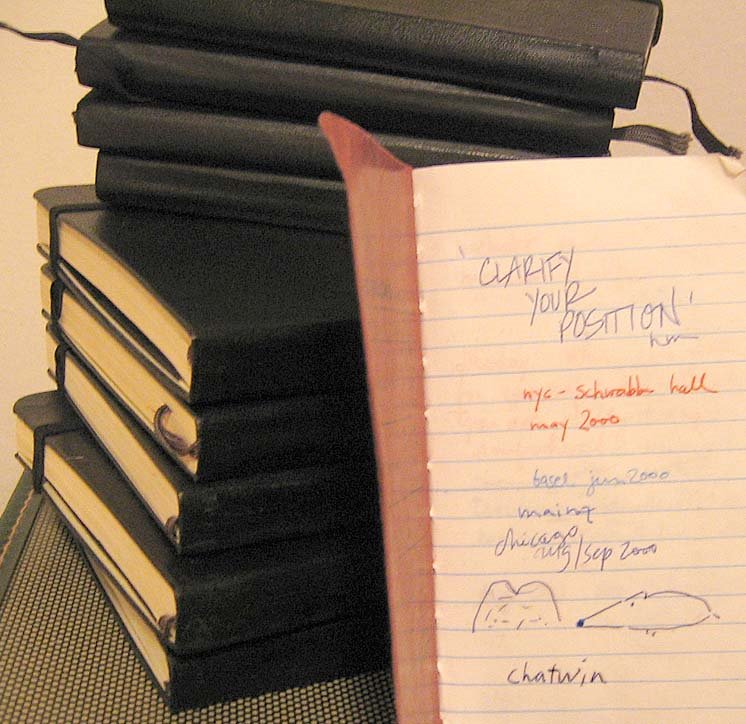
Finally, I placed my little notebook and a pen in front of him. He drew an
animal: a mole next to a molehill. And then he named the mole Chatwin.

His sketch and pantomime revealed information of little interest to me then:
Bruce Chatwin was a writer; Chatwin used notebooks of which the cover was made of the skin of moles; Modo & Modo somewhere in Italy were now producing these notebooks and my charades partner was involved in designing them.

10 months later in Frankfurt, in a book shop I realized how great Moleskines were and
how interesting Bruce Chatwin THE travel-writer is. I've been a fan of both since.

Today, I got another Moleskine. I freed it from it's cellophane packaging and running my hand over the sleek black cover thought fondly of my introduction to the cult of Moleskine. I cracked open the notebook and gingerly took out the little pamphlet from the inner pocket and read the history in English, yet again.

Today, I read it en français, too and that is when I realized for the first time that these notebooks were "Produit à l'origine par de petites manufactures françaises . . .", hmm. I looked up moleskine in my French dictionary. It means imitation leather. Duh! Non, sans blague!

Vive les taupes!


le carnet légendaire = the legendary notebook

"Produit à l'origine par de petites manufactures françaises . . ." = "originally produced by small French bookbinders . . ."

sans blague! = no joke! / duh!

la taupe = mole

vive les taupes = long live the moles


Photo: My stack of beloved Moleskines and the original "chatwin-mole" drawing

aujourd'hui en Allemagne


Moleskine™ is a Trademark of Modo & Modo © All Rights Reserved

Tuesday, April 04, 2006

Say what?


Quoi?!

"Zhe parhrlay fransay", I would say to myself trying to build up some confidence.
Je parle français, tu parles, il, elle, on parle, nous parlons, vous parlez, ils elles parlent, I would write (practice makes perfect).

I would go on French vacations and recite faithfully from my Berlitz phrase book: "parhrlay voo ahnggleh?" Of course no one French ever heard me say "zhe parhrlay fransay" because it wasn't a claim I could make. A simple "non" was uttered in place of "je ne parle pas français" on the very few occasions I was asked and understood the question. It was a painless answer for me and my French listener.

So for years (my phrase book is from 1996!) I was not aware of my elemental French faux pas. I knew that French wasn't pronounced as written- but I didn't know to what degree. Now I'm starting to learn and getting very muet though it feels more like mute!

On the plus side, look how easy it is to pronounce the conjugations of regular ER verbs in the present (silent!): four for one (it looks like a bargain, doesn't it?)


je parle
tu parles

il, elle, on parle
ils, elles parlent


On the other side- if you can't look, listen to how much harder it becomes to recognize the word that's being said (ils and elles sound like il and elle as well!)
c'est ce qu'on dit:


Merci beaucoup Sebastien.


C'est ce qu'on dit = That's what they say
muet (nm) = tongue-tied
parler = to speak, to talk
Je parle français = I speak French
Je ne parles pas français = I don't speak French
Parlez-vous anglais? = Do you speak English?

Photo: un Singe (macaca sylvanus) à Gibraltar, janvier 2006

Friday, March 31, 2006

Poisson d'avril


Tomorrow, if you are in France, and you aren't careful– you might find a cardboard fish on your back: poisson d'avril! If you aren't thinking it of yourself: Que je suis bête! someone else is and laughing.

The origin of April Fools' Day is not clear with many cultures indulging in
and enjoying making fools of their compatriotes since ancient Rome and the festival of Hilaria (known today as Roman Laughing Day).

The French are generally credited with April Fools' Day because it's
marked on THEIR calendar. Before 1582, the eight-day celebration of the new year culminated on April 1st. In 1582, the Gregorian calendar was introduced and new year's day was moved to January 1st. Those who didn't hear about the date change or stubbornly refused the new calendar were labeled as fools and ridiculed. That explains the date of this holiday.

What about the fish? Some of the explanations I've come across seem a little far-fetched: ...a joke to depict them as 'April Fish' that represented young and naïve fishes that are easily caught on the first day of April; Some believe that the fish is tied to Jesus Christ, who was often represented as a fish in early Christian times. Others say the fish is related to the zodiac sign of Pisces, which is represented by a fish, and falls near April.


Whatever the reason for the fish- if you happen to find one on your back tomorrow
it might be of some consolation to find yourself in the company of the great Napoleon, who earned the Poisson d'Avril monicker when he married Marie-Louise of Austria on April 1, 1810. An unwanted cardboard fish in France is certainly better than waking up the next day in Las Vegas with an unwanted marriage certificate pinned on your back.

So- watch your back on April 1st!


le premier avril = April Fools' Day, also known as All Fools' Day
poisson d'avril = April fool, literally "April fish"

Que je suis bête! = What a fool I am!

Photo: Looking out from inside The Tube (at theDFS Galleria Waikiki shopping mall) a 65,000-gallon, two-story saltwater aquarium you can actually stroll through.

Hawaii, en septembre 2002

Monday, March 27, 2006

Heure d'été and the Learned


How smart the French are!
Whether you mean daylight saving time or summer time they both translate to heure d'été. Even though we in the European Union have already lost our precious hour yesterday (those in the USA hang onto theirs until the first Sunday of April) we have gained the right to start planning our summer vacation today! What a great way to start a Monday, oui?

More of the savant French!
What's on your list of fantastic places to visit in France? Is Urville on it? Because the only way to describe this city and its creator, Gilles Trehin, is fantastique!


savant = literally 'knowing (person), learned, knowledgeable

savoir = to know

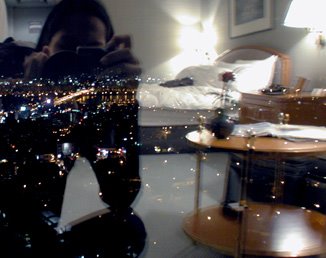
Photo: à Séoul, la capitale de la Corée, en octubre 2003

Tuesday, March 21, 2006

Is that you?


"As-tu pété?" and really a French speaker isn't asking if your name is Pete.
"Oui, je péte" and no your not telling them, yes you are.

English has been so strongly shaped by French that it's estimated that English speakers who have never studied French already know 15,000 words! Although the American Association of Teachers of French insist that "French is Not a ‘Foreign' Language!", all of you Peters out there should know better instinctively.


Péter is a verb and not welcome to conjugate himself anywhere without risk of embarassment and unpleasant odors until someone answers the Prize Question that Benjamin Franklin suggested to the Royal Academy of Brussels:

"My prize question therefore should be: to discover some Drug, wholesome and not disagreeable, to be mixed with our common food, or sauces, that shall render the natural discharges of Wind from our Bodies not only inoffensive but agreeable as perfumes."


French IS a foreign language even if we have thousands of cognates.
Péter is definitely a faux-ami, but flatulence? A true friend!


péter (émettre un gaz intestinal) vulgaire = to fart

un pet (gaz expulsé) = a fart

une flatulence (gaz, aérophagie) = flatulence


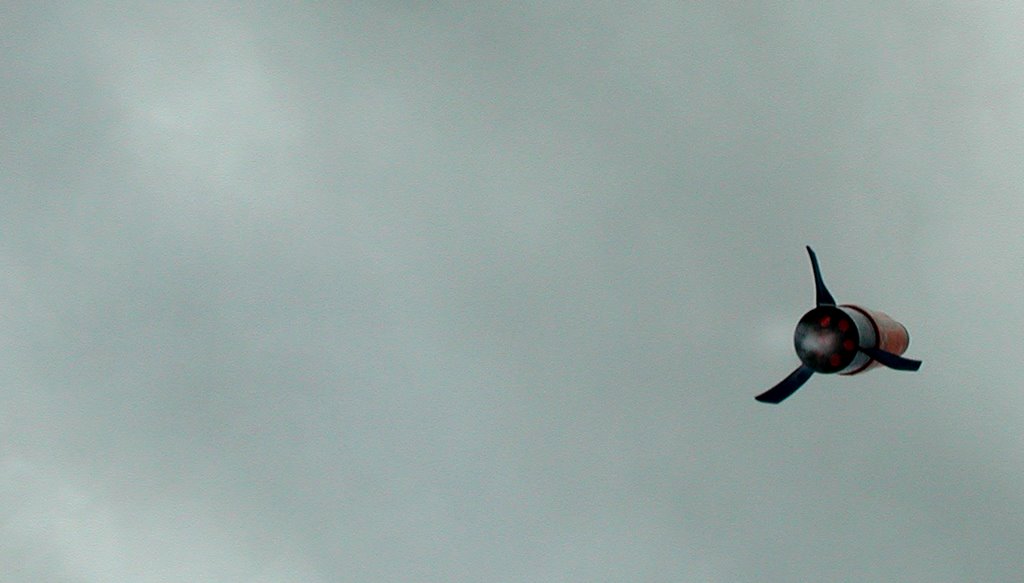
Photo: "Kosmos Rocket" en Allemagne, en
juin 2002

Friday, March 17, 2006

TGIF!


Merci mon Dieu, c'est vendredi!


It's Friday, thank your God. If you are like me, you hop out of bed tossing aside the
warm covers hugging instead the possibilities of a fleeting weekend.

Thank God it's Friday! It's the incantation that brings the work week to a close
before your feet even hit the floor. If you are like me.

Merci mon Dieu, c'est vendredi. Merci mon Dieu, c'est vendredi! It's the singsong refrain
that keeps my feet moving happily from my bedroom door to my office. My feet, tucked beneath my computer desk tap out: Merci! mon dieu! C'est vendredi! drumming out all the mishaps and frustrations of the week as the clock ticks me nearer the weekend.

Oui, le week-end, which the very mention of, brings on dancing feet!

Ça suffit comme ça!


Ça suffit comme ça = enough, now it's quitting time

Photo: Harlem à New York City, en septembre 2005

Monday, March 13, 2006

Concours d'adresse


Game of Skill

Do you know what the following means?


1 - Taille tôt, taille tard, taille toujours en mars

2 - Sème tes pois à la saint-Patrice, tu en auras tout ton caprice

3 - Quand mars se déguise en été, avril prend ses habits fourrés

More importantly, can you translate it into English? If you answered yes and aren't a French citizen or French is not your mother tongue then you've definitely got skills.

If you are game: go to www.FrenchPodClas.com, read the rules and maybe you'll be the historic prize winner of the first Game of the Week, (podcast 35). Hurry, this week's game ends on March 15! Bonne chance.

Et moi? Encore charabia, charabia, charabia!


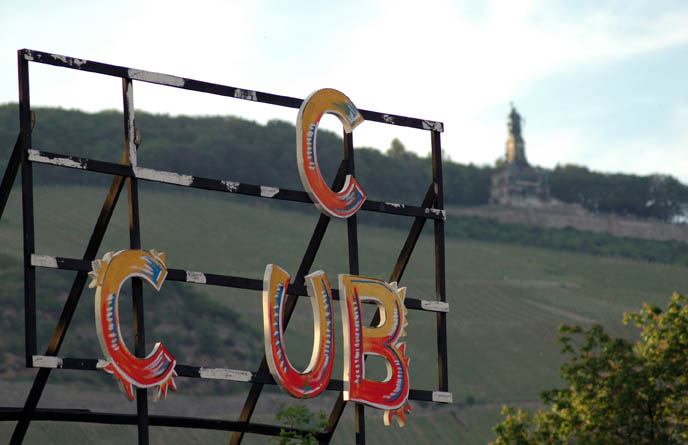
Photo: Niederwald Denkmal also known as Germania in the background
à Bingen en Allemagne, en mai 2005

Friday, March 10, 2006

Faites de beaux rêves


Sweet Dreams


Not long ago, I awoke from a dream completely astounded. I was speaking French. Fluent French gibberish. This must be how my teachers sometimes hear me mangling French: charabia, charabia, charabia!

Does this dream mean anything? Do I need to do more French homework? Will I never make it past grammaire progressive niveau débutant to grammaire progressive intermédiaire?

M'aider dream dictionary! I look up "French". Apparently, it is a better thing to dream that I am speaking French than to see or eat French fries. What a relief: I am not "overlooking the frivolous and seemingly minute things in life".


le charabia = gibberish, mumbo jumbo, gobbledygook
Faites de beaux rêves = sweet dreams, literally: make beautiful dreams

English synonyms for gibberish that I've never heard in a conversation but nonetheless do exist: eyewash, piffle, twaddle, poppycock. Love to hear what the French equivalents are!

Photo: à Buenos Aires en Argentine, en mai 2004

Monday, March 06, 2006

Je vous présente un moucheron exceptionnel


Illustration Friday's
theme this week is "insecte".

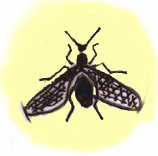
Mon amie, Damsel Fly, has obliged me by supplying her drawing of a special pollinator. It's no ordinary mouche and should not be confused with it's relative, le moustique (known to stephi as "flying moustaches").

Why you should love this fly:

1- Midges have no ability to bite and do not carry any human diseases.
2- Midges are superlative: la plus rapide! They beat their wings over 1000 times per second!
3- Midges are pollinating agents: Bonjour, cocoa tree! They are little chocolate makers!

Vive les moucherons! La joie du chocolat!


un insecte = insect
une mouche = fly
un moucheron = midge fly
un moustique = mosquito
mon amie = an exception to the rule, my friend (fem.)

L'illustration: "Chocobug" depicts a Midge Fly, also known as Forcipomyia
Illustratice: Damsel Fly © 2002

Saturday, March 04, 2006

What a little "beau" can do for you!


One of the very first words I learned in French was the adjective beau.

In English it means a dandy or a male admirer, boyfriend or lover that is usually rich and fashionable. (That's what girls really mean when they say a guy is handsome, isn't it?)

As a French adjective beau is everywhere identifying the beautiful: from être beau garçon to le beau monde. As if that wasn't enough, the French beau proves that he isn't just another pretty face. He's a hard worker impacting the French language with transformative powers that goes beyond beautification:

beau with nouns

un père = father > beau père = father-in-law, stepfather

bébé = baby > beau bébé = bouncing baby

parleur = talker > beau parleur = big mouth, smooth talker


beau with verbs
il fait beau = nice weather

faire le pluie et le beau temps = to call the shots

Il fait le beau = he is showing off
on a beau dire = say what you like

j'ai beau essayer, je ne comprends pas = try as I might, I don't understand
faire le beau (dog) = to sit up and beg

beau with the devil

se démener comme un beau diable = struggle like a madman

(from what I understand used in the sense of trying to escape from something)


être beau garçon = good looking boy
le beau monde = high society
belle is the femine form of beau


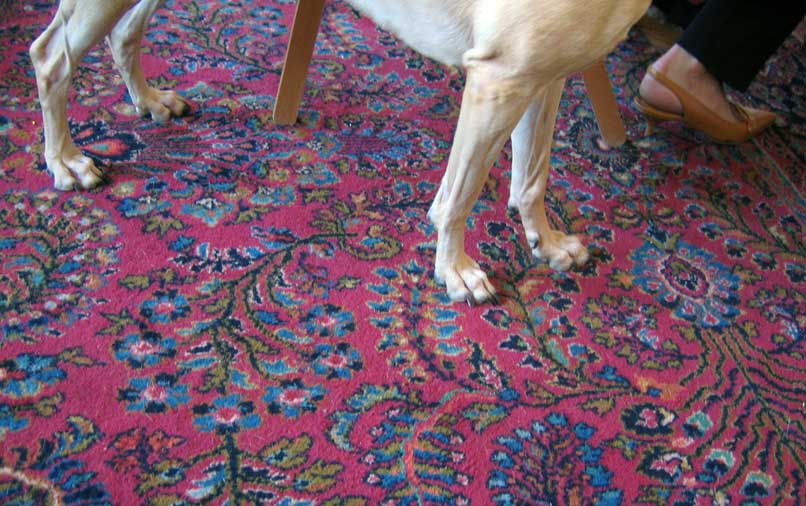
Photo: Hear Dinky, the amazing singing dingo, chez Jim's Place
à Stuart Wells en Australie, en octobre 2004

Tuesday, February 28, 2006

Happy Birthday, Michel Eyquem de Montaigne!


If at first you don't succeed...


Today is the birthday of Montaigne, the great essayist. Most certainly even considered THE greatest by his French compatriots (stick an "e" between the "t" and "s" and it's already French, people!). In fact, in his official portrait, former French president Mitterand holds an open copy of the Essays in his hands.


Montaigne is considered to be the inventor of the personal essay.
He published a book titled Essais in 1580. He was the first person to call short pieces of prose "essays" from the French word for... oui, attempt!

...try, try and try again.

Yes, the mantra for anyone attempting to learn anything when things don't go right, right away, will now remind me of Montaigne. This, in turn, offers me a course of action by association: If I can't get it right and I'm tired of trying- I'll just write about it!


essayer = to try

un essai = an attempt


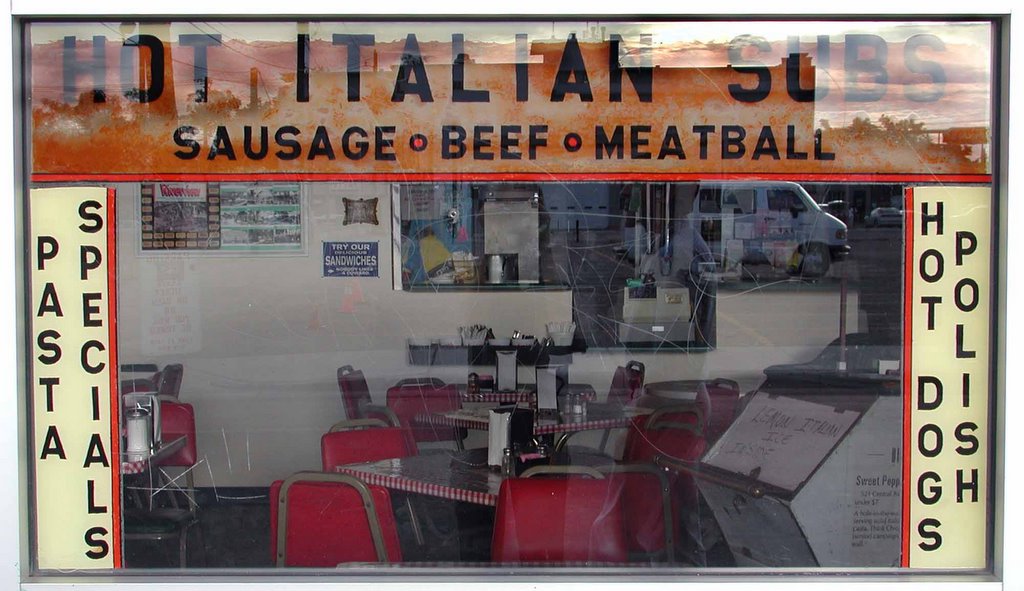
Photo: Try our delicious sandwiches

au Nouveau-Mexique, en septembre 2001

Friday, February 24, 2006

Tohu-Bohu


For weeks I was happily fumbling about in the French present with limited forays into one sort of past (passé composé) and a only a peek at the "going to..." future (futur proche). Then suddenly my teacher ripped me out of my present happiness and dragged me at mach 5 across the french timelines further into the land of tohu-bohu (yep- sounds exactly what I'm talking about: confusion)!


présent (equivalent to three different English tenses)
passé composé (equivalent to three different English tenses)
imparfait
futur
futur proche

To be quite frank, I'm just getting a grip on the present. I am content with limited retrospection and not having to worry about what lies ahead, in any language.

Here I am with the the possibilities of articulating my past, present and future with a dizzying array of endings in French. Go ahead, ask me a question in any tense!

So what DO I do with la question du jour: Quels sont vos plans pour ce week-end? Brave on and answer resolutely with I will or I am going to? No, mes amis, I stay firmly rooted in the comfortable présent and hope for the best:

Mes plans ce week-end est de me soigner.
J'espère avoir une bonne journée avec une "presque-tout-petit déjeuner"!!
J'espère regarder un bon film, peut-être même un film français.
Je veux aussi faire la grasse matinee.
Bon weekend tout le monde!

...and hoping is one way of sneaking out of conjugating the future, oui?

Je espère = I hope

Photo: On the grounds of Hacienda la Boticaria
à Alcála de Guadaira, le premier de l'an dans 2006

Tuesday, February 21, 2006

Oui Mec!


I took a week off from my French lessons but was lucky enough to have a surprise chance to interact with French speakers in Genève, Switzerland. I tagged along on a drive that took six hours round-trip for a meeting that didn't quite last as long as our coffee stops.

The meeting was a tour of the company in French and English. There wasn't much for me to do but smile and nod, "oui":

Oui, I understood a French word you said about 3 sentences ago
Oui, I understand your English very well
Oui, très bien- fantastic work!

It was all really quite impressive. Especially since the company representatives continued to speak in French to me, too despite the fact that I was basically monosyllabic and repetitive in French. No doubt I was a "yes-man" of sorts that day: weak in my French and totally agreeable to whatever was being said. But not all bèni-oui-oui are like that!

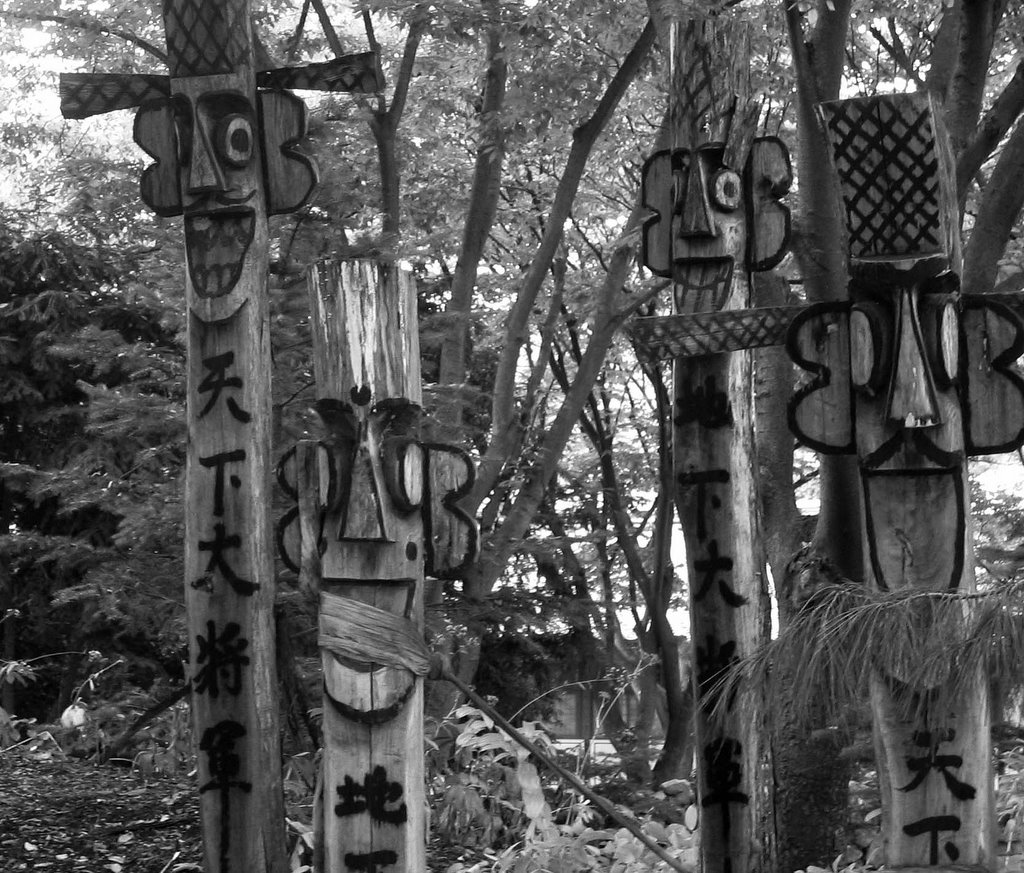
Photo: Wooden totem poles representing gods who supposedly live in the big shrine tree.
Seen at the Korean Folk Village à Suwon en Corée, en octobre 2003

Sunday, February 12, 2006

Beauty is in the Eye of the Beholder


I have just learned that, in French, a relative by marriage
is basically a beautiful thing. What I plainly refer to in English as my parents-in-law or in-laws translates to beaux parents or belle-famille.

ALL the new members of the French family are lovely:
beau-père
belle-mère or belle-maman
belle-soeur
beau-frère (which can be shortened to beauf
)

And in the eyes of your beautiful in-laws, YOU are...? Suddenly, there is a choice. Either they find you beautiful as well: belle-fille or beau-fils or they just acknowledge you as "the spouse of my child". In which case you are either a bru (daughter-in-law) or gendre (son-in-law).


And your own parents, brothers and sisters? There is no French adjective to automatically beautify their existence. I suppose this is not a problem as most of us have already spent enough time with our own family that, well, other adjectives quickly come to mind.

Photo: en Allemagne du Sud, en novembre 2004

Tuesday, February 07, 2006

Mayday! Mayday!


Uhm actually, just help me.


I am adrift in a sea of my French babblings. I am to describe a picture for mes devoirs. My teacher has given me a diving board of great beginnings from which to show off how much French I've learned and to demonstrate my understanding of the works of art she's chosen:

Je me rends compte...
Je m'aperçois que...
Il se dégage une impression de...
La scène est captivante grâce à...

Jump! Jump! Jump! But I can't quite complete these sentences. I cannot say in French what I realize or perceive. I cannot say what sort of impressions the picture radiates nor why the scene is captivating. Not yet, not today. Peut-être demain, je suis optimiste.

Instead of jumping into the deep end of confusing French (le français confus? compliqué? embrouillant?) I call out mayday, mayday, m'aider or m'aidez!
Oh, oui- the international distress signal is just us English speakers mispronouncing French (again!).


The mispronounced m'aider or m'aidez is used to call for help in life-threatening situations. In the US it's a federal crime to cry a wolfy mayday with punishments of up to six years imprisonment and a fine of $250,000. In French, pronounced correctly, it loses its sense of extreme urgency and is, as in English, a request for help.

With that in mind, I stick to French but with an independent American attitude:
je m'aide. I help myself. I go back to the shore of my basic knowledge. I wade in the comfort of simply attempting to say what is there and how it looks:


Il y a une sculpture, un homme...
Il est orange, très mystérieux...

Photo: Récif de la Grande Barrière d'Australie, en novembre 2004

Friday, February 03, 2006

What's Love Got to Do with It?


Je t'aime.

Those three words (posing and sounding as two) make a lot of people swoon. Those are words of love! Well... not only.

Pre-French-Class I thought that Je t'aime was akin to a marriage proposal.
Je t'aime. I love you, he says and you say it back and voila you are one step nearer that altar. Well, okay- not in France.

In France, they fully understand the meaning of aimer: to love or to like. Oui! Let's rewind to that summer of love in France- "Je t'aime," he said over and over but after the summer it was "au revoir" or maybe the heavenly farewell "adieu." You were crushed. No phone calls or letters when autumn came. Winter was indeed very cold.

That summer of love- it was maybe just the summer of like.

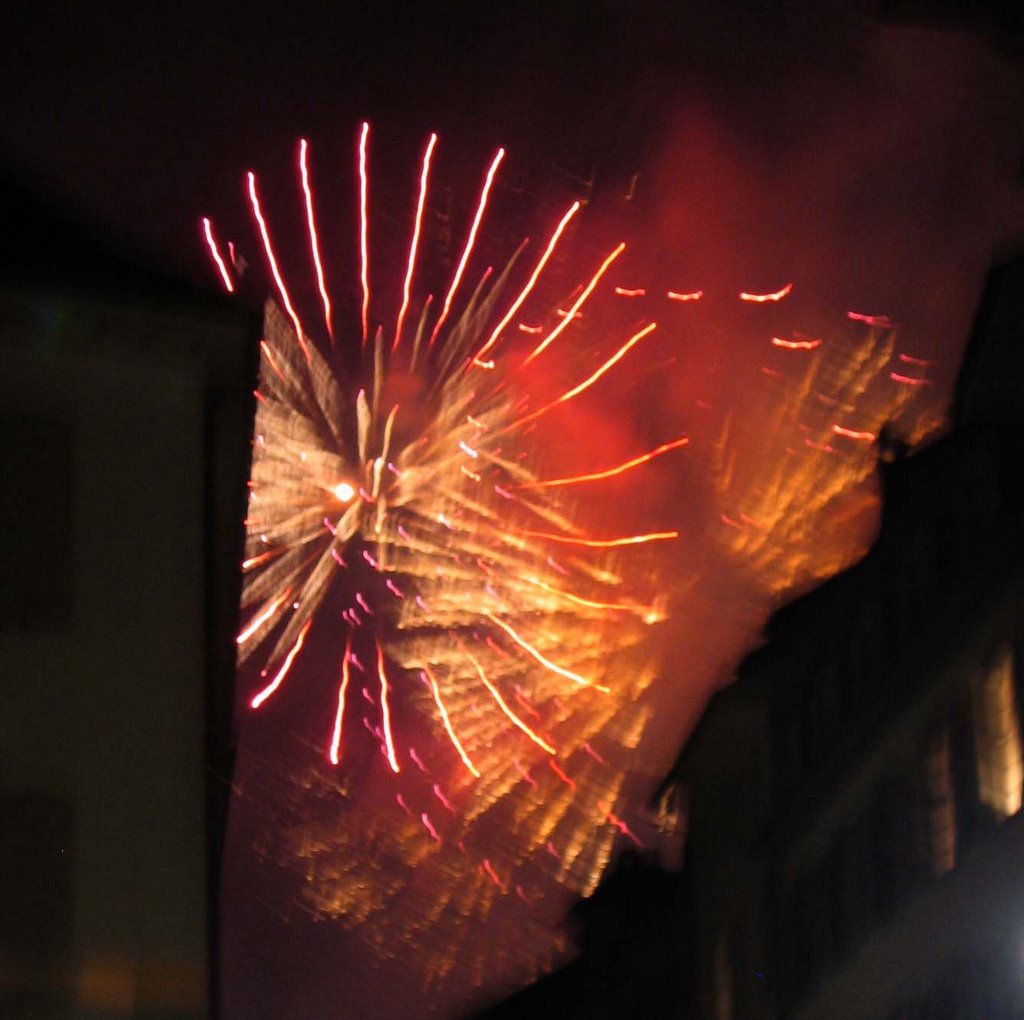
Photo: Swiss National Day, Feux d'artifice over Basel
minuit, en juillet 2005