Il est américain. Elle est américaine.He/She is american. Il est grand. Elle est grande. He/She is tall. Il est brun.Elle est brune.He/She is brown-haired.
L'exception: he and I are both jeune et mince (among other exceptional qualities). No changes there - one "e", included for both.
I confess! When it comes to French grammar, I'm basically guessing. It's my way of building up intuition. Thinking grammar through is just not my forte. I just want to "know" what to say, say it and have it be right. I'd rather not torture my brain through analysis until minutes or hours later I can reason my way into a sentence that should be perfect... only to stumble into the l'exception pitfall. I don't have the patience for this and certainly the French, in my limited experience, don't want to witness the torture of their language either.
My teacher is explaining a few grammar points and pausing frequently to ask me if I understand. My answers go from the "uh-huh" of hopeful but questionable comprehension quickly to that of unquestionable incomprehension: "I guess... mmm... I guess..." My voice trails off wanting to stop guessing and instead think about other things: un gâteau au chocolat, Paris, l'amour...
What to learn from all of this? Today's vocabulary word: "I guess". My teacher paused, "hmmm... I guess would translate to je pense". Well, I may just start guessing everything à la française because thinking is better than "just" guessing, isn't it? Hmm, je pense...
the French we already know: le fort forte(specialty) l'analyse (fem) analysis l'exception (fem) exception la patience patience l'expérience (fem) experience la compréhension comprehension l'incompréhension (fem) incomprehension
penser to think, to guess un gâteau au chocolat chocolate cake l'amour (mas) love
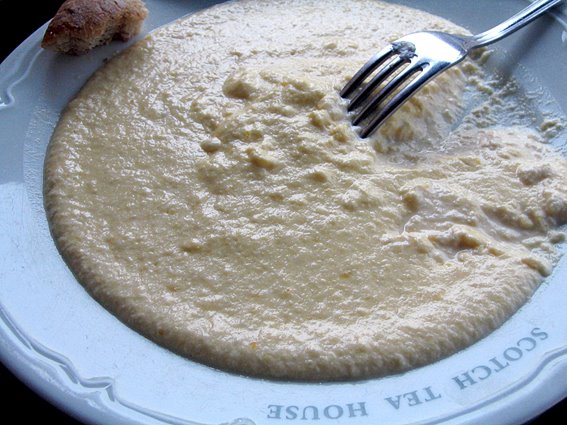
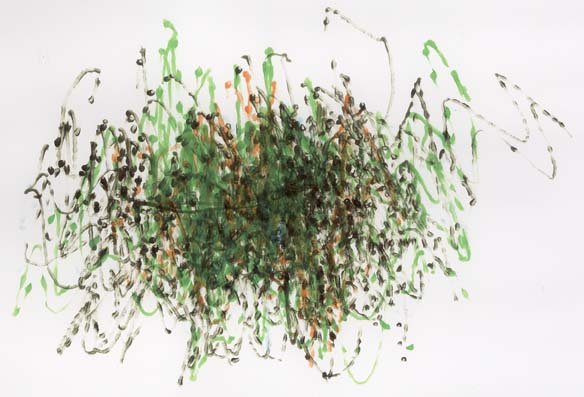
La photo: Guess what? It's supposed to be œufs brouillés! (It could pass for my brain on grammar though...) Au Scotch Tea House, à Nice. Juin 2006
After my short holiday from learning French mutated into an extended strike - how fitting is it that my first lesson upon return is about l'imparfait?
The imperfect is not only the lapsed débutante de français, moi - but the French past tense that wants you to know there's a another reason to learn the nous and vous verb forms in the present tense.
I hadn't been bothering to completely conjugate all the verbs that I've been learning. I can speak for myself: Je parle anglais. I can turn a simple sentence into a question for my teacher: Parles-tu anglais? (in the familiar because, oui, je tutoie!). I can also tell you about somebody, he or sheas easily as "je": il parle/elle parle/on parle anglais! (tu also likes sharing verb forms with je on many occassions.)
I was basically content to stumble when conjugating the nous and vous forms because they rarely came up. That is, until I took a trip into the French imperfect past. Suddenly they are the foundation upon which habits and states of beings are built - just replace the endings in the nous or vous present form:
parler = nous parlons, vous parlezwe speak, you (formal) speak boire = nous buvons, vous buvezwe drink, you (formal) drink (je bois, tu bois, il/elle/on boit, ils/elles boivent)
with the proper imperfect endings: je parlaisI was speaking, I used to speak tu parlais il/elle/on parlait nous parlions vous parliez ils/elles parlaient
je buvaisI was drinking, I used to drink tu buvais il/elle/on buvait nous buvions vous buviez ils/elles buvaient
The French usually take their vacation in August. My mind instinctively took a vacation, too - happily following my body to Glasgow, Chicago, Jakarta and Ubud - leaving behind French grammar and homework.
But while the French returned from their holidays in September my mind turned to another French pastime and decided to follow suit: it went on strike. It decided to continue to indulge in recreation. There would be no conjugating, no adding to the vocabulary, no reviewing. There wouldn't even be the pretense of good intentions: no taking the grammar workbook only to stuff it into the literature pocket of a Recaro airplane seat behind the safety-cards; no lugging the Apple laptop poolside only to ignore the Microsoft Word document containing pages of vocabulary; not even toting the beloved Moleskine around village, town, city, or the island to jot down musings à la c'est intéressant.
I went through my days barely noticing the increasing absence of French in my daily life. I was content with slowly acclimatizing myself to the plateau that I didn't realize I had reached: I did only half of my overdue homework, I watched a French film with German subtitles while leafing through a magazine and managed to answer only one question du jour each week, if at all. Still, I felt confident about my French- thinking it would be the bicycle I would ride effortlessly once I chose to finally get back on.
I mean, I would at least be able call up the Paris Marriott Hotel and somehow come up with a sentence that would have me speaking to my friend in room 132, right? Crashing realization as I began with "je" followed by silence and then finally "voudrais" as I soldiered on battling more awkward silence until I finally fell apart - "..uhm aaah diiiiiire" - stretching out my words hoping to stall for some time.
The receptionist had had enough and brusquely demanded, in perfect English, that I stop butchering a language that sounded otherwise so lovely: "please! speak English". I acquiesced and mumbled my request.
To English speakers it's known as the Hippocampus. No, I'm not talking about seahorses or hippos.
Does it sound Greek to you? Guess what, it IS! The hippocampus does take its name from the Greek: hippo = horse, kampos = sea monster.
Okay- but what's so intéressant about this "monster"? Well, this monster is in our brain. It's the part that's responsible for memory. It can be ton meilleur ami or ton ennemi juré in language learning.
Réviser, réviser, réviser! Words of wisdom gladly repeated by teachers everywhere. In this case, French. But what if you've reached a plateau and reviewing isn't getting you anywhere anymore?
According to Berhard Hobelsberger's article in issue three of Brigitte Balance (bonjour aux lecteurs allemands!) there's a better way to review. And it has to do with the Hippocampus.
The Hippocampus is basically not a friend of repetition. What does that mean for those of us who want to avoid being at odds with our français and our hippocampe? It means saying the same thing in different ways - instead of just repeating the same phrase over and over - is going to help you learn it faster and better because l'hippocampe likes to hear "new" things.
Hobelsberger's other tip to get your Hippocampus friendly and listening? Change the tone of your voice!
mon exemple: Je crie. I scream. Tu cries. You scream. Nous crions tous pour une crème glacée. We all scream for ice cream. Tu as criè, "Je veux une crème glacée". "I want ice cream", you screamed. Tu veux crier, "crème glacée!" You want to scream "ice cream!"
repeat after him:
ton meilleur ami your best friend ton ennemi juré your worst enemy réviser to review
La photo: Atherton Tablelands en Australie. Octobre 2004. Posted from the air en route to Indonesia! Merci Boeing connexion!
I'm not in France or a French-speaking country so I cannot easily absorb French through ma vie au quotidien. The French that's available to me is limited. There's one channel on la télé that leaves me saying "huh?" after the first five minutes. Weekly rentals at my local library of les disques vidéos has me currently at letter "F". That translates to 4 movies.
And les livres? Well I'm on page three of understanding Coke en Stock. I actually don't know what the title means. Looking it up online at WordRef and piecing it together gets me "cocaine in stock". I am definitely misunderstanding this aventure de Tintin.
Clearly, I have to make a quotidian if not herculean effort in addition to my homework to make the quantum leap in French. The following sites help - of course the trick is to visit them tous les jours!
du jour (actuel) current; aliment (fresh) ma vie au quotidien my daily life la télé television le disque vidéo digital video disk (dvd) le livre book aventure de Tintin adventure of Tintin (comics) tous les jours every day, daily; everyday, each day
Le theme de cette semaine le site d'IllustrationFriday est "play". Of course the interpretation of the word "play" is left open to the imagination. Je choisis de jouer!
He's kind and so is she. To the French: il est gentil et elle est gentille. They are both beautiful and happy. In France: Il est beau et heureux et elle est belle et heureuse. She's quite patient - but he?
elle, americaine: tu es impatiente! il, française: impatient (masc.), impatiente (fem.), l'impatience elle: you have the impatience of a woman then! il - he smiles and chuckles. Apparently he also has a bon sens de l'humour.
It was on this day, a month ago in Nice that I saw the exhibition Perdre la tête currently at the Théâtre de la Photograhie et de l'Image (til 27 août). Get to know the streets and people of Paris: large format black and white prints of lost heads (or rather obscured - much better than being guillotined) contrasted by a series of revealing portraits (many are headshots) from Parisian photographer François-Marie Banier.
As there is no more losing heads by guillotine today- it won't be rolling heads but craziness or absentmindedness to deal with when a Frenchman declares "je perds la tête". But if the Frenchman says "tu me fais perdre la tête" with a look of mischevious madness in his eyes... well maybe you'd better head for the hills unless of course you are also éperdument amoureuse!
perdre la tête lose your head, to be forgetful je perds la tête literally "I am losing the head" - I am going crazy; forgetting things tu me fais perdre la tête "you make me lose the head" - meaning he has a crush on you éperdument amoureuse a girl head over heels in love éperdument amoureux a boy head over heels in love
La photo - Catherine Deneuve à Cannes, en Juin 2006
If you can say that three times fast with your best Frech accent and you understand what you are saying then you may be ready for writer Raymond Queneau. Doukipudonktan is the first word of Queneau's 1959 book Zazie dans le métro.
Still struggling to pronounceD'où qu'ils puent donc tant?- then perhaps you'd rather hear it than attempt to read it aloud. A year after the book's publication Philippe Noiret, as tonton Gabriel, wonders "Why do they stink so much?" in Louis Malle's film adaptation.
Zazie is essentially about a little girl who simply wants to ride the métro. That's where the simplicity stops though. The bobbed-haired heroine with a toothy grin holds her own with the grown-ups at repartee and gets herself ingeniously in and out of trouble.
For those seeking a playful introduction to nouvelle vague or looking for an amusing jaunt through Paris– follow Malle into Zazie's absurd world. In his film version Zazie outruns the adults and shows off Paris: her grand boulevards, Saint-Vincent-de-Paul, Place de la Concord, la Tour Eiffel and much more. She dodges tonton Gabriel, villians, cars, plates of sauerkraut and even pulls cartoon-style slapstick gags with the finesse of Tom and Jerry. Does she get to ride in the métro?Watch the movie and find out the meaning of grève.
As for me, reading and pronouncing Doukipudonktan is still much easier than D'où qu'ils puent donc tant. C'est la vie d'une débutante en français– moi!
Il parle, je parle - nous parlons:
D'où qu'ils puent donc tant? (trés familier! not polite) Pourquoi est ce qu'ils sentent aussi mauvais ? (the polite, correct form ) both mean: Why do they stink so much? tonton (familier), oncle uncle tante aunt nouvelle vague French new wave (cinema) C'est la vie d'une débutante en français– moi! That's life for a beginner of French– me!
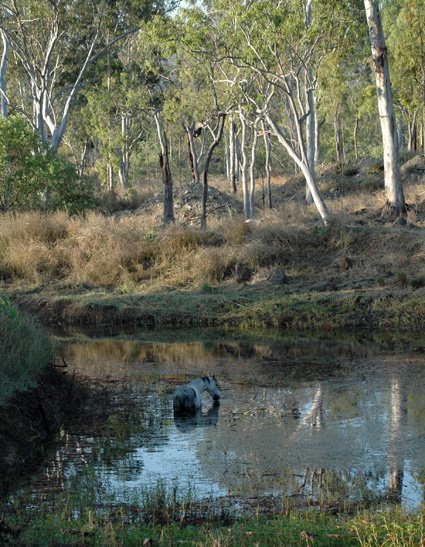
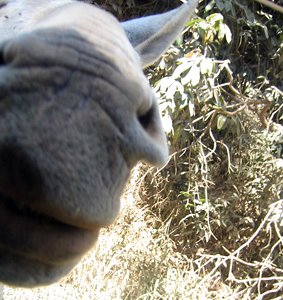
La photo: Sniffing mule en Australie. Octobre 2004
In French, being ok is when "it goes": ça va. Not only can you say ça va to indicate your well-being but you can also say the movie was ok, the food was ok, the plane trip was ok... basically everything has the potential to be ok, if not "interesting".
In the present you can answer ça va to both questions : Comment allez vous?How are you? Comment est le livre?How is the book?
In the past you you have to differentiate between yourself and a thing or situation: j'étais okI was ok c'étais okit was ok
In the future, to assure people that you will be okay or maybe assure them that their situation or experience of something like reading that book will be ok you can say ça ira.
It's easy to be or find something ok in the present and the future: everything, including you "is or will be going". In the past, distinctions must be made between you and it and it is a matter of "being" rather than "going". But in the end, tout est ok or even better, tout va bien!
say it loud- say it proud:
ça ira I will / it will be ok (literally "I or it will be going") tout est ok everything is ok tout va bien everything is good (literally "everything goes good")
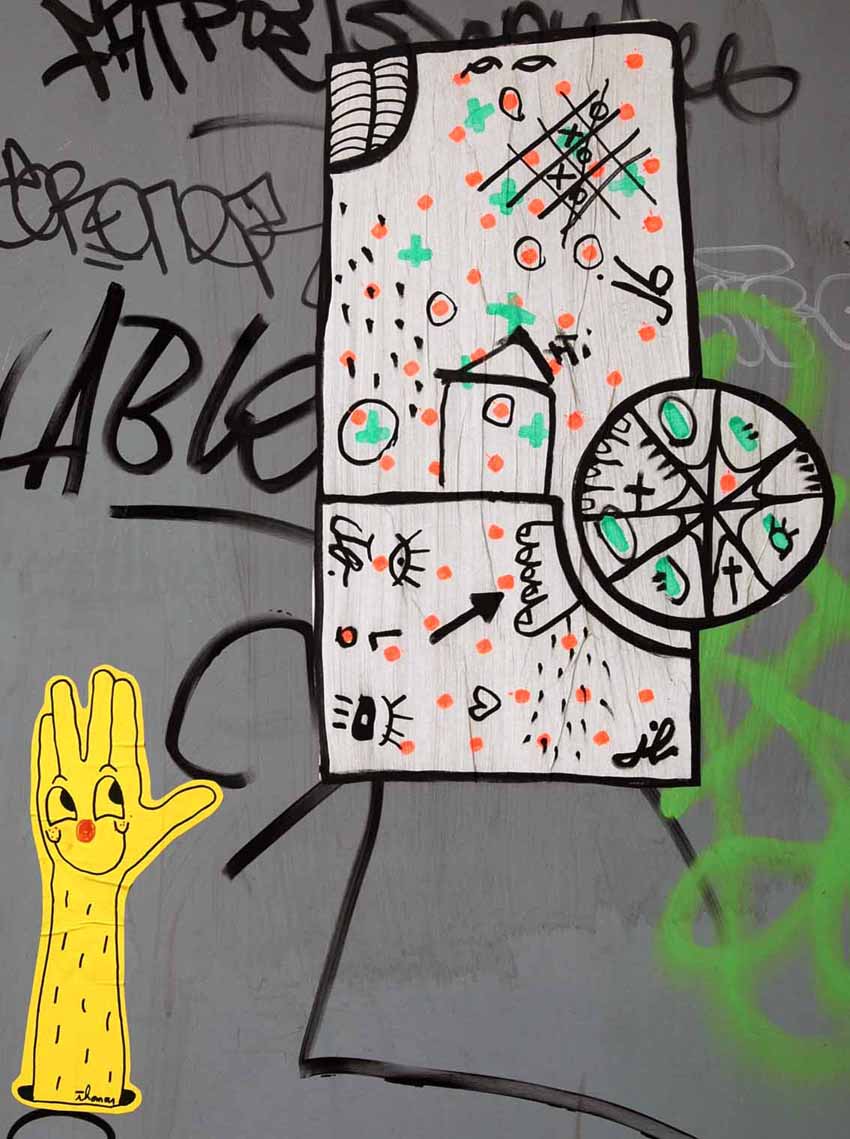
La photo: Street Art à Nice, en France. Juin 2006.
For my trip to Ville de Nice I was briefed that s'il vous plaît or je voudraiswasn't going to cut it. It wasn't, literally, "nice" - or rather niçois, enough.
In order to get my salade niçoise with a smile, I'd have to go beyond demanding: Je voudrais une salade niçoise.
And if I wanted some some tap water I'd have to be extra polite andask with sugar on top:Est-ce que je pourrais avoir une carafe d'eau, s'il vous plaît.
If you want bottled water- just ask politely specifiying the brand:Est-ce que je peux avoir une Pellegrino?
s'il vous plaît please (formal) s'il te plaît please (familiar) je voudrais... I would like...
Puis-je avoir une salade niçoise? Est-ce que je peux avoir une salade niçoise? both mean: Can I have a salad niçoise?
Est-ce que je pourrais avoir une carafe d'eau, s'il vous plaît. Could I have a carafe of water, please?
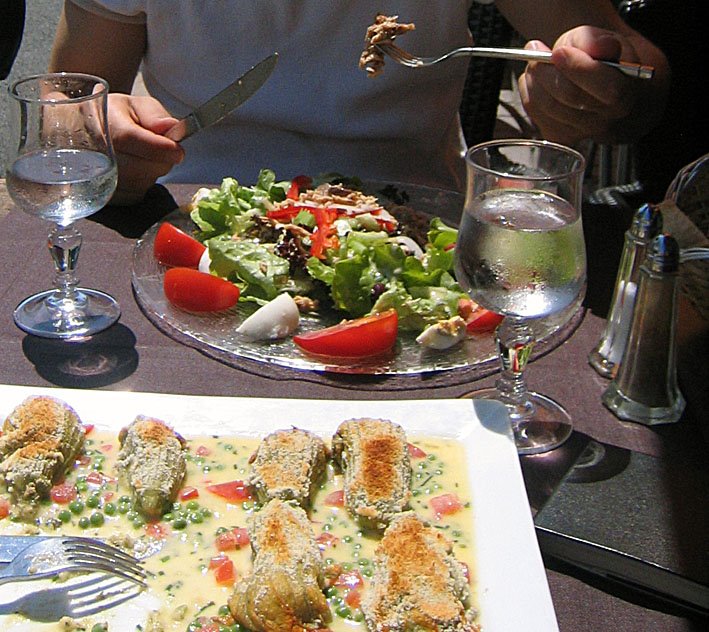
La photo: salade niçoise (11,60 €) et fleuers de courgettes (14,50 €) at L'Authentic: 18 bis, rue Biscarra à Nice. The most I paid for a salade niçoise but it was also the best I tasted out of four! Juin 2006
and since the first of this month you can support Reporters without Borders by also buying the book "100 photos de foot pour la liberté de la presse" “Football : 100 photos for press freedom” http://www.rsf.org/print.php3?id_article=17931
Tout sur le football bresilien en francais, anglais et portuguais All about Brazilian soccer in French, Portuguese and English Well, the Brazilians are the defending champions so... http://www.sambafoot.com/fr/
drive your friends nuts- listen, memorize and repeat, repeat, repeat!!!
La photo: la couverture de l’album "100 photos de foot pour la liberté de la presse"
When I think of having a French drink- it's usually champagne that comes to mind. But when my thirst hits me in Manufactum, a store that's still in love with the quality goods of the good old days, I'm not picky. Luckily, I don't have to settle for less than the queen of lemonades.
My first glance at the bottles had me erroneously reading rien instead of reine mistaking the queen for the "Nothing of Lemonades". Ouais- my thirst was definitely getting the better of me. I obey my thirst and grab two bottles: original lemon flavor and mandarine.
La Mortuacienne was created by Marcel Alcide Rième in 1921 in the French Jura where it's still being produced today. I'm curious to have a sip of something that's lasted this long. Both drinks are made of carbonated mineral water, sugar and citric acid. The mandarin flavor has color additives.
My first sip is "pur sucre" and reminds me of lollipops- especially the mandarin. There's no sugary aftertaste though. My thirst is quenched but I'm thinking la mortuacienne could use a little cîroc. But that's another taste test.
Ouais (marque l'accord) uh-huh (when you agree) la mandarine mandarin pur sucre pure sugar
La photo: Les boissons de Morteau, trouvé en Allemagne. En Juin, 2006.
Ouh là! The vocabulary I've been learning lately IS coming in handy.
Not exactly talking about working the words in a French conversation but understanding them and the words that surround them. I'm grasping sentences! I know Eddie isn't talking about a "smile" under the table. I can laugh when the French laugh. Bien sûr, it helps that half the stand-up is in English. Je comprends I understand Ouh là wow
la vidéo: Eddie Izzard, "Dressed to Kill" Found on the internet (You tube) today
You'd think that if you've heard one cat "meow"- you've heard them all. But a French cat goes "miaou".
"Here kitty kitty" or even "ici minou minou" is not going to get a French cat near you. You have to say "bi biss".
But saying "viens ici, mon minou" might get your sweetheart near you. Or not.
un chat/une chatte = a cat (m/f) le minou = the cat, kitty cat, pussycat (m+f); can be used as a term of endearment viens ici, mon minou = come here, my cat
Cat got your tongue could be translated with: tu as mangé ta langue = you ate your tongue tu as avalé ta langue = you swallowed your tongue
La question du jour had me thinking about creepy, crawly, slimy snakes and insects. Berk!
I shuddered at the thought and looked over the answers that were already there. The first answer perplexed me. Les souris? Huh? I read it out loud to myself. Hmmm... sounds familiar.
Oh yeah, smile. Wait. What?! Smile? She's afraid of a smile? I read the second answer. Someone else is afraid of this animal?! Maybe it's slang?
Ilooked it up online and was greeted by smiles. Below the bright smile I found something that may indeed cause fear (although not for elephants): a mouse.
berk = yuck le sourire = smile, grin je souris = I smile tu souris = you smile la souris = mouse, computer mouse
la photo: Mascot of the Dubai Summer Surprises aux Émirates arabes unis, juin 2005
Today, there are a lot of muchachos and muchachas celebrating General Ignacio Zaragoza's underdog victory over French invaders at the Battle of Puebla in Mexico in 1862. A stampede of cattle was even set off as part of the effort to stop and literally crush the invasion.
Today, Cinco de Mayo is also widely celebrated in the United States where it seems to be doubly as festive than in Mexico. And indeed, why not? Mexican-Americans have twice the reason to celebrate: Zaragoza's victory also prevented the French from helping the rebel Confederates. Understandably there isn't any celebrating in France today. However, the French don't have to wait long to celebrate and enjoy a day off: May 8 is la fête de la victoire! On Monday, France and the rest of Europe celebrate the end of the Second World War.
Cinco de Mayo = 5th of May la fête de la victoire! = VE Day
la photo: Apache Canyon Ranch Bed & Breakfast à Laguna (Albuquerque) au Nouveau-Mexique, en septembre 2001
There's a lot going on under the sea. It's not just for fish or divers. If you are a science fiction enthusiast and a lover of extraordinary voyages then it's for you, too.
But if you do like history and diving as well– then go to the Island of San Telmo on the coast of Panama. Standing on the beach at low tide you can already see one of only five existing submersible crafts that were built before 1870. Dive in to get a closer look at the Sub Marine Explorer invented by Julius Koehler and imagine yourself vingt mille lieues sous les mers . . .
sous-marin = undersea; submersible; submarine sur terre = on land vingt mille lieues sous les mers = 20,000 Leagues Under the Sea (published in 1870)
L'illustration: Unter dem Meer Illustrateur: The nephew's imagination covers a Din A4 page. He unknowingly accepted the challenge of this week's IllustrationFriday theme.
Jamais-- at first glance and because I'm still scraping myself off the Autobahn of Tohu-Bohu-- seems to me short for for j'aimais or j'aimerais. However, far from loving, jamais means never.
How quickly never turns into love, anyway! In the morning I am telling my friend, "je n'achèterai jamais deux paires de la même chaussure" (pre-French days, so actually I was saying "I would never buy two pairs of the same shoe"). Blasphemy for those words to be said by a woman- and une philippinienne no less.
Shortly after, I go into town to replace my worn-out favorite shoes. I didn't know it then but I'd come to the proverbial French fountain from which I declared I wanted no water.
I take off my shoes, point to the replacements and tell the salesclerk, "J'aimerais deux paires!"
"Yes," I assure her, "the same shoe, the same color."
In the afternoon I am back at my friend's. I am eating my words and washing them down with French fountain water while happily showing her my new shoes. J'aime mes deux paires de chaussures!
Moral of story:I'm no good at refusing drinks from a French fountain.
ne . . . jamais = never j'aimais = I was loving ... (l'imparfait, French imperfect) j'aimerais = I would love ... (conditionnel, conditional)
Il ne faut jamais dire jamais = Never say never Il ne faut pas dire fontaine = Never say fountain shortened from:Il ne faut pas dire, "Fontaine, je ne boirais pas de ton eau" = Never say, "Fountain, I will not drink your water"
J'aime mes deux paires de chaussures! = I'm loving my two pairs of shoes!
la photo: mes chaussures préférés à Monterosso, Les Cinque Terre en Italie en juillet 2003












 Posts
Posts


